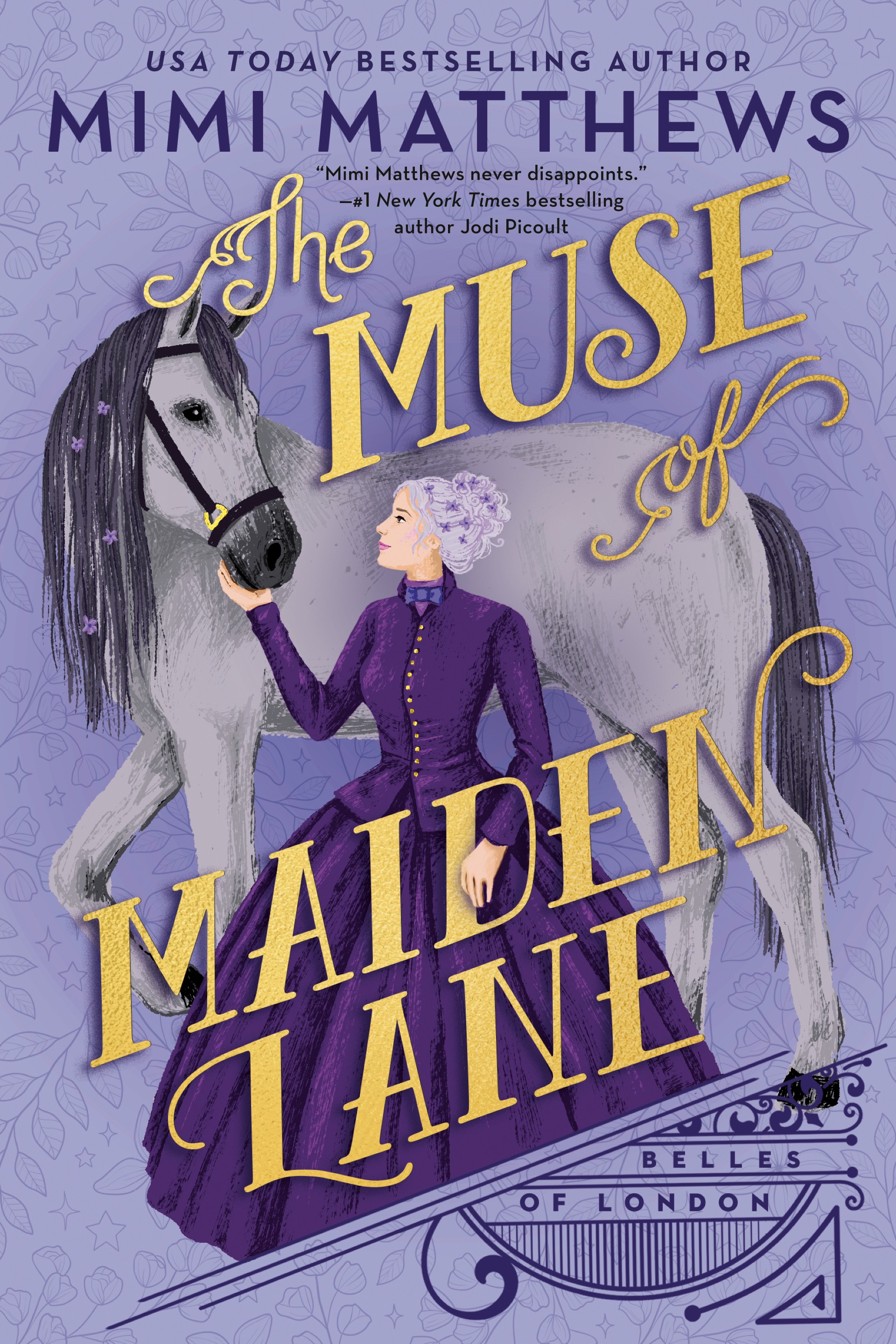
 About the Book
A silver-haired equestrienne and a charismatic artist turn a scandalous bargain into a vibrant portrait of love.
Stella Hobhouse is a brilliant rider, stalwart friend, skilled sketch artist—and completely overlooked. Her outmodish gray hair makes her invisible to London society. Combined with her brother’s pious restrictions and her dwindling inheritance, Stella is on the verge of a lifetime marooned in Derbyshire as a spinster. Unless she does something drastic…like posing for a daring new style of portrait by the only man who’s ever really seen her.
Aspiring painter Edward “Teddy” Hayes knows true beauty when he sees it. He would never ask Stella to risk her reputation as an artist’s model but in the five years since a virulent bout of scarlet fever left him partially paralyzed, Teddy has learned to heed good fortune when he finds it. He’ll do anything to persuade his muse to pose for him, even if he must offer her a marriage of convenience.
After all, though Teddy has yearned to trace Stella’s luminous beauty on canvas since their chance meeting, her heart is what he truly aches to capture….
 Available at Amazon U.S. The Muse of Maiden Lane
About the Author 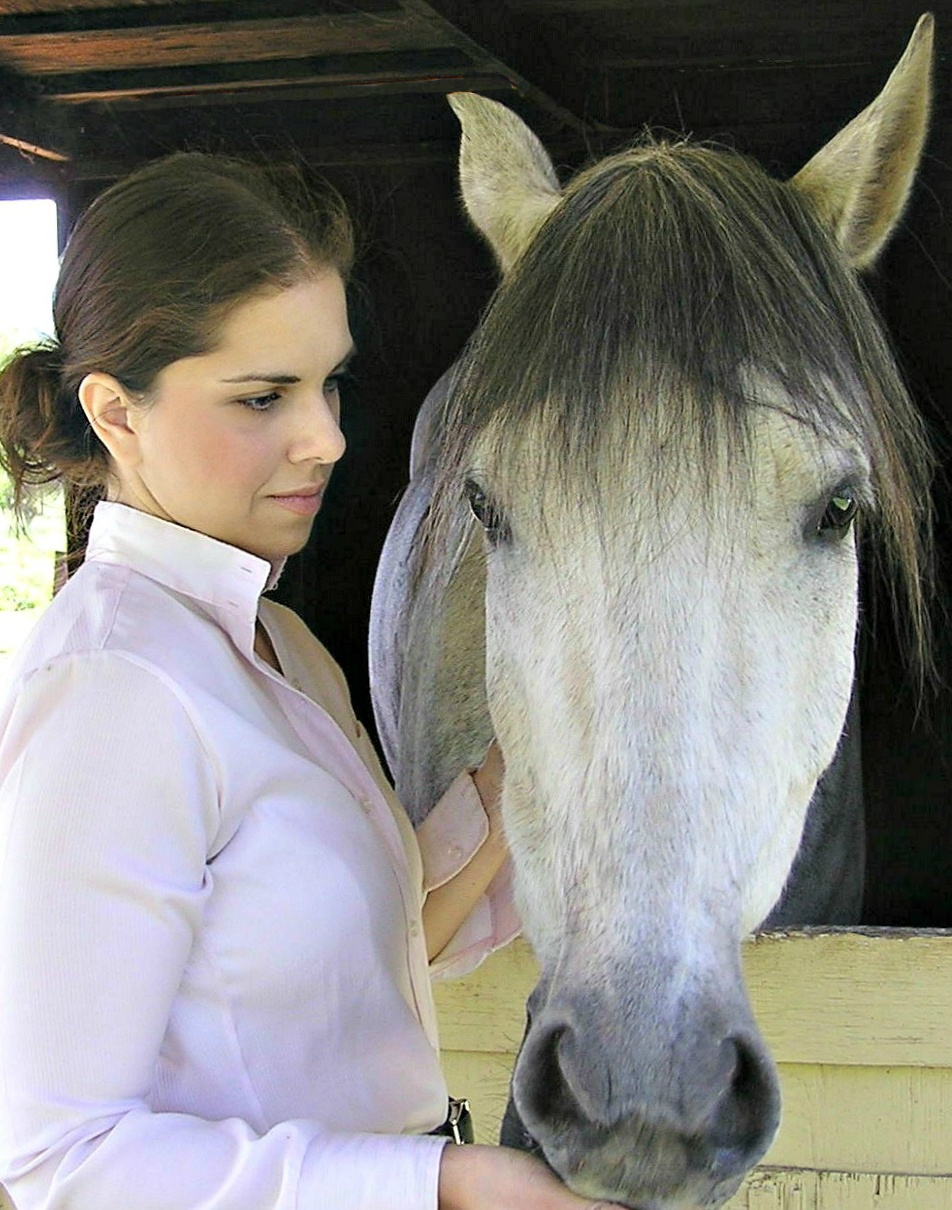
USA Today bestselling author Mimi Matthews writes both historical nonfiction and award-winning Victorian romances. Her novels have received starred reviews in Publishers Weekly, Library Journal, Booklist, Kirkus, and Shelf Awareness, and her articles have been featured on the Victorian Web, the Journal of Victorian Culture, and in syndication at BUST Magazine. In her other life, Mimi is an attorney. She resides in California with her family, which includes a retired Andalusian dressage horse, a Sheltie, and two Siamese cats. Learn more online at www.mimimatthews.com. (Photo by Vickie Hahn)
Read an Excerpt
Teddy Hayes rolled his wheeled chair into the dim interior of the anteroom. He wasn’t about to wait for a gilt-edged invitation. Not after he’d spent the last three months excoriating himself for not discovering the mysterious young lady’s name on the last occasion they’d met. He’d been so thunderstruck by her then, so jaw droppingly dazzled, that it hadn’t even occurred to him to ask until after she’d gone. By then, it was too late. There had been no one around who could enlighten him. No fashionable acquaintances who might know her identity. Such was the price of being new to London. Teddy was a visitor here. A guest, not a member of polite society. Aside from the small circle of friends that his older sister, Laura, and her husband, Alex Archer, surrounded themselves with, there was no one to whom Teddy could apply for information. Love his relations as he did, he was reluctant to ask them for help in such matters. Some things were private. Especially when it came to the subject of silver-haired goddesses he’d encountered in the British Museum. “Why did you run away?” he asked. The young lady stood with her back to the wall. Her white pearl- and crepe-festooned skirts bowed out in front of her in an arc of petticoats and crinoline. “I did no such thing,” she said stiffly. It was the first she’d spoken since he’d entered the room. She had a soft, even voice, with a hint of velvet at the back of it. The kind of voice that could soothe as easily as it could seduce. Teddy’s blood thrummed with an unexpected pulse of heat. He instantly dismissed the feeling. He hadn’t gone after her because he was attracted to her. Not as a man, anyway. His interest was purely artistic. “You did,” he said. The same moment he’d clapped eyes on her from across the crowded ballroom, she’d spun on her heel and disappeared out the doors in a flurry of glittering skirts. He’d been left staring after her in dismay as the orchestra struck up the opening waltz, wondering for all of fifteen seconds whether he’d been mistaken. “I felt a little faint,” she replied, a trifle defensively. “I needed air.” “And you’re taking it here?” He cast a dubious glance around the anteroom as he wheeled himself to the nearest lamp. It sat upon a low inlaid walnut table beside one of the damask-upholstered settees. Striking a friction match, he lit the wick. The room was at once bathed in a soft halo of light. “You might at least have opened a window.” “It’s storming outside,” she replied as he turned his chair to face her. “In case you hadn’t noticed.” Teddy examined her in the glow of the lamp. She looked different than she had that day at the British Museum. He should know. The memory of her had been etched into his brain for months. It wasn’t because she was the most beautiful woman he’d ever seen-though she was beautiful. It was because she was different. And not just an oddity in her manner, or in the style of her dress or coiffure. She was strikingly different. When he’d encountered her that day in the King’s Gallery, her hair had been uniformly silver-the color of fine platinum or sterling. When coupled with her silver-blue eyes and the tender gravity of her manner, it had given her the look of a shimmering, vaporous spirit, newly alighted from the heavens to engage with lowly humankind. She’d reminded him of one of the mythological Pleiades-the seven sisters the Greek god Zeus had famously transformed into stars to grace the night sky. Teddy had never in his life seen a woman who better embodied the myth. As an artist, the sight hadn’t failed to make an impression on him. “I notice everything,” he said. The young lady’s throat worked on a delicate swallow. She edged toward the door. “I beg your pardon. I must return to the ballroom. My friends will be wondering-” “I trust you’re not afraid of me?” She stilled. Her lips compressed in a vaguely affronted line. “Indeed, I am not.” “You appear so.” “If I do, it’s only because I don’t know you.” “We’ve met before,” he reminded her. “It was some months ago. You were in the King’s Gallery of the British Museum admiring a Van Dyck drawing.” “I remember,” she said frostily.
His mouth quirked. Naturally, she did. He’d offended her then. Been too blunt. Too free with his opinions. It was a failing of his, one made worse by the virulent strain of scarlet fever he’d contracted in his youth. The illness had left his legs partially paralyzed, but had done nothing to curb the sharpness of his mind. Indeed, his sister often remarked that the more Teddy felt constrained by his disability, the less of a guard he was willing to set on his tongue. It wasn’t deliberate. He didn’t mean to be rude or unkind. But he knew firsthand how short life could be, and how suddenly it might all come to an end. The time one had left was too precious to squander. He had no patience for mincing words. “I recommended a painting to you,” he said. “Mr. Whistler’s new piece-The Woman in White. It was on display at the Berners Street Gallery at the time.” She blushed to the roots of her hair. Her auburn hair. It was now the same shade as the titian-haired lady depicted in Whistler’s painting. “I could hardly forget,” she said. “It doesn’t follow that I know you. We haven’t been introduced. Not properly.” “That’s easily remedied.” He wheeled a half turn closer to her. “My name is Edward Hayes. Most everyone calls me Teddy. And you are?” “Stella Hobhouse,” she blurted out, “but that isn’t the point-” “Stella,” he repeated. A pleased smile tugged at his mouth. “Like a star.” Surely it was a sign? He was meant to find her again. She drew herself up with offended dignity. “I did not give you permission to use my Christian name.” “Why shouldn’t I when it’s so beautiful?” He wheeled nearer. “By the by . . . what happened to your silver hair, Stella?” Her mouth fell open. “Why that’s . . . that’s none of your business!” “You dyed it, I suppose.” He frowned. “I wish you wouldn’t have.” “How dare you, sir? To presume to make personal remarks about my-” She broke off. “Is this how you address ladies of your acquaintance?” “With honesty and candor? Indeed, it is how I address ladies. It’s the same way I address gentlemen. I see no need to insult you by dancing about with euphemisms.”
“It’s not an insult. It’s decorum. Politeness. There are rules-” “Yes, I’ve heard of them. I suppose that’s how it must be in London. But we’re not in London any longer. We’re in Hampshire.” His smile returned. “And house parties are wild places, I’m told.” She stared at him, the expression in her silvery blue eyes both intrigued and appalled. “How is it that you come to be here at Sutton Park? Do you know Lord March?” “I don’t,” he admitted. “Then what are you doing at his house party?” “I’m not here by choice,” he said. “My sister and brother-in-law were invited. As I traveled with them from France, they thought it best I accompany them.” It had been the only way to set Laura’s mind at ease. He’d been in his chair for nearly five years, the first several of which she’d been his caregiver. It was a difficult role for her to relinquish. Never mind that Teddy was better now than he’d been in ages. She still worried about him to an excessive degree. “They told me there would be great opportunities for sketching.” He cast a grim glance at the rain beating down upon the windows. “I’m reserving judgment.” She inched toward the door. “Your relations are acquainted with Lord March?” “Only slightly. My brother-in-law is arranging to purchase a new strain of the earl’s roses for our perfumery in Grasse. Hayes’s Perfumes. Perhaps you’ve heard of us?” Again, she stilled, her curiosity seeming to get the better of her. “Hayes’s Lavender Water?” She brightened with recognition. “Is that you?” For once, Teddy was grateful for the negligible fame that his late father’s perfume business brought to the family name. “It’s partly me. I inherited half of the company when my father died. But it’s my sister and brother-in-law who run it. My interests lie elsewhere.” “You’re an artist,” she said. “I am.” He paused. “May I ask you an impertinent question?” She huffed a reluctant laugh. “Haven’t you already?”
His smile broadened. “Tell me, Stella-” Her chin dipped. She shook her head. “Please don’t call me that.” “Tell me, Miss Hobhouse,” he amended. “Would you object to my painting you?”
Excerpted from The Muse of Maiden Lane by Mimi Matthews Copyright © 2024 by Mimi Matthews. Excerpted by permission of Berkley. All rights reserved. No part of this excerpt may be reproduced or reprinted without permission in writing from the publisher.




 rosesareblue.net